You are already collecting powerful information about children every day—quick notes, photos, and anecdotes. The question is not whether you document, but what you do with those observations. When we treat documentation as a planning tool, not just a record, we move from reacting in the moment to anticipating needs and designing environments where children can thrive.
In this post, I want to show you three practical ways to turn your existing documentation into more intentional, confident planning.

1. Look for the when — not only the what
Most documentation captures what happened:
“Sam hit.”
“Maya cried at cleanup.”
“Three children argued in the block area.”
These statements are a starting point, but they do not yet help you plan. To turn a note into a planning tool, add the when and the conditions around the behavior.
Instead of only writing “Sam hit,” try capturing details such as:
- When during the day it happened (arrival, transition, last 10 minutes outside)
- What was happening in the environment (crowded space, loud voices, limited materials)
- What Sam was trying to access (a specific toy, a peer, a space)
- What adults did right before and right after
For example, your note might become: “Sam hit when three children crowded at the train table right before cleanup, after the five-minute warning, when there were no trains left.”
Now you have something you can plan around. You can adjust when you give warnings, how many children can be at the table, or how trains are shared. The behavior is still important, but the timing and context point directly to your next step.
2. Adjust the environment — not only the student
When documentation shows a pattern, it is tempting to focus only on the child: “Sam needs to stop hitting.” But your notes often reveal something else: the environment is asking children to do more than their current skills allow. That is a planning opportunity.
Imagine your notes from the week read:
- “Conflict in block area during center time.”
- “Children yelling and grabbing blocks near the doorway.”
- “Two children in tears when another child knocks down their buildings.”
Instead of starting with, “How do I get them to share better?” start with, “What is this environment asking of them?” Then use your documentation to design specific changes:
- Use a two-child visual limit. Post a clear, simple visual that shows only two children in the block area. This reduces crowding and gives children a concrete cue when the space is full.
- Clarify sharing expectations. Teach and post one or two clear expectations, such as “We build together” or “We wait for a turn with the big blocks,” so children know what sharing looks like in that space.
- Move the block area away from the doorway. If your notes show frequent disruptions as people enter and exit, relocate the blocks so children have a more protected space to build without constant traffic.
In each case, you are still supporting individual children, but you are doing it by changing the conditions around them. That is high-quality, intentional planning—and it comes directly from your documentation.
3. Teach the missing skill before it is needed
Documentation often shows us where children struggle in the moment — during transitions, at cleanup, when lining up, or when it is time to leave a preferred activity. Instead of waiting for those hard moments and then correcting, we can use our notes to decide what to practice in advance.
For example, if your notes show that lining up is consistently chaotic, you might plan a brief practice outside of transition time. Gather the group when everyone is calm and say, “We’re going to practice how our class lines up.” Then introduce a simple, playful cue:
“We line up like turtles — slow and quiet.”
Invite children to show you what “turtle line” looks and sounds like. You can practice moving from the carpet to the door, or from one side of the room to the other, while you name and reinforce the specific skills you see: walking feet, quiet voices, hands to self, eyes on the teacher.
You can do the same for other challenging routines your documentation highlights—such as calm transitions from outdoors to indoors, or getting ready for nap. When you teach the missing skill before it is needed, children are far more able to meet the expectations you have set.
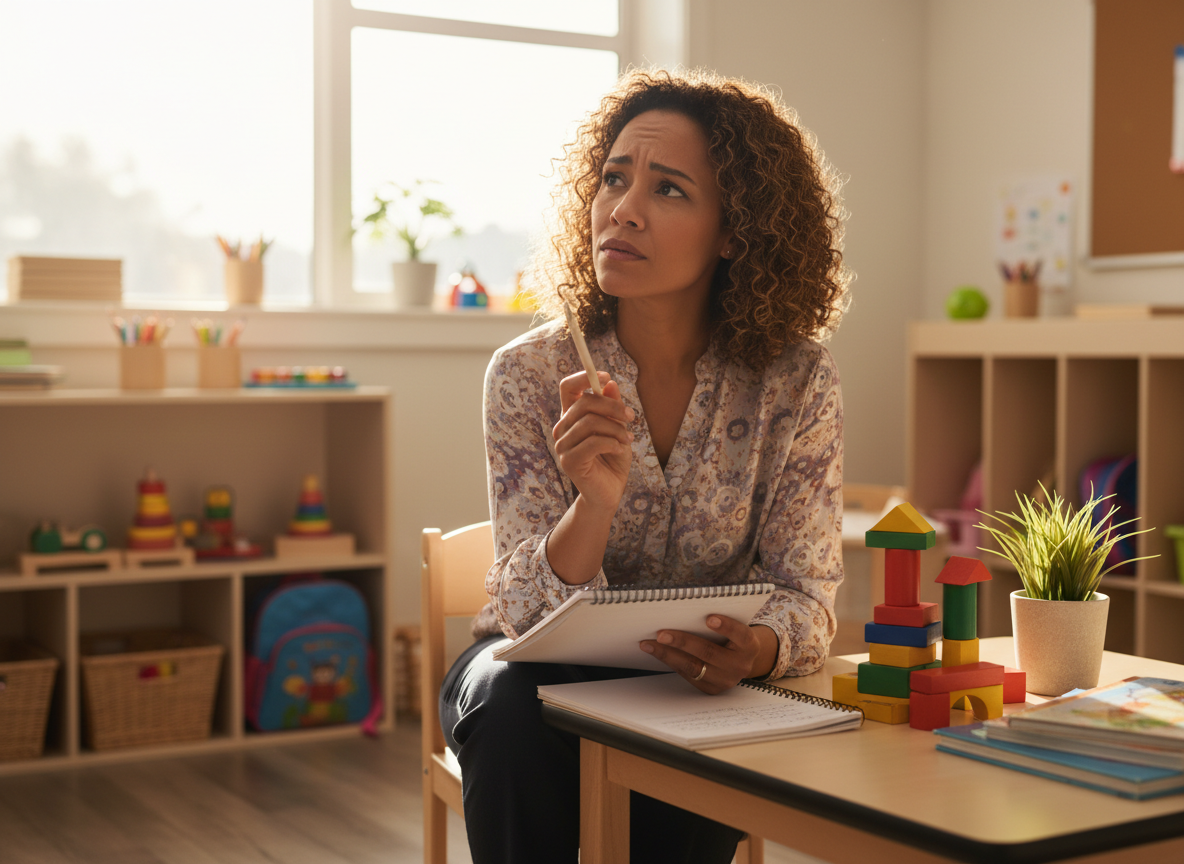
Documentation as a Planning Tool
When you look for the when, adjust the environment, and teach missing skills ahead of time, your documentation stops being a list of problems and becomes a roadmap for growth. This is the work of a reflective, intentional educator—and it is how you build both your confidence and children’s success over time.
Every note you take is a chance to ask, “What is this telling me about what children need next, and how can I plan for that?” That is how you move from feeling reactive to leading your classroom with clarity and purpose.
Let’s Discuss
Take one note from last week’s documentation and read it with fresh eyes. What does it tell you about the when, the environment, or a missing skill? Identify one adjustment you will make in your planning for this week based on that single note.
If you’d like more structured support in turning your daily observations into confident, effective plans, my books and coaching are designed for exactly that purpose.
— Cristina


Leave a comment